
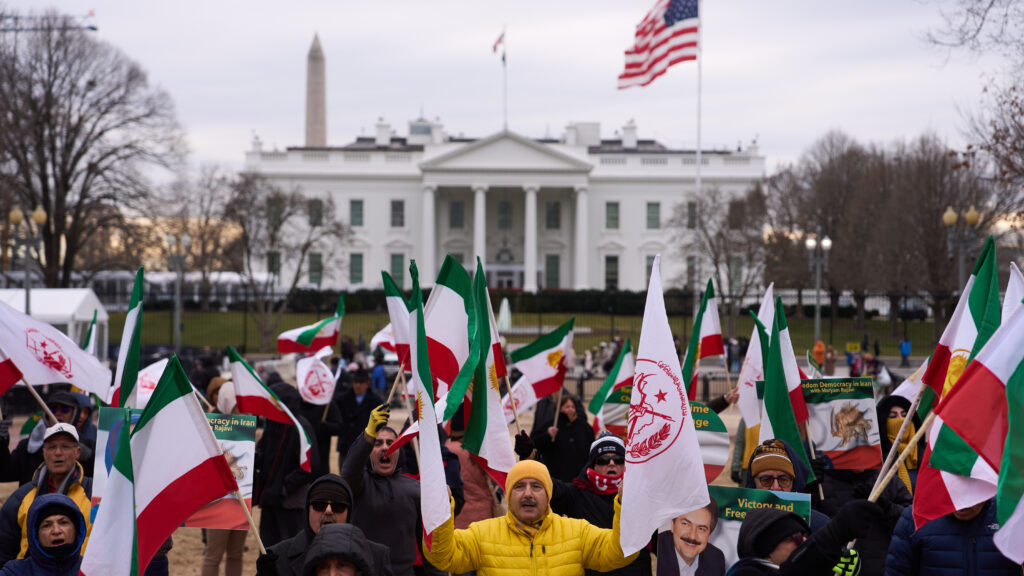
The prospect of war between US and Iran has been dominating news since the start of the year, but just today it seems both sides are giving mixed signals.
Though the US Navy has stationed a carrier strike group off the Iranian coast, Iran’s foreign minister has said today that he’s “confident” they can reach an agreement – a sentiment echoed by President Trump. At the same time, diplomatic relations between Iran and the European Union seem to have broken down.
Amid all the conflicting headlines, it’s difficult to figure out what’s really going on and where it’s going.
Are we on the road to war, or a peace deal?
How did this conflict start, and what are America’s motivations and objectives?
And importantly, what’s next…?
Why is this happening?
There are a few reasons why Iran is currently embroiled in crisis: acceleration of their nuclear program, and domestic unrest.
Reports over the last year had predicted that Iran was closer than ever to “nuclear breakout”: the point where they have enough enriched uranium to build a bomb. In response, the US launched strikes against the nation’s nuclear sites in June, despite no substantial evidence of the nuclear weapons development. In December, Trump again suggested Iran was “building up weapons” and warned of consequences “more powerful than the last time.”
Going forwards to now, US ships are stationed in the Gulf and Trump is demanding Iran “make a deal” that ensures they have “NO NUCLEAR WEAPONS”, despite Iran maintaining that their nuclear program is entirely peaceful.
However, this supposed threat of a nuclear-armed Iran was not Trump’s original rationale for the US’s recent involvement…
Iran has also been embroiled in the legacy of “Bloody January” – where widespread anti-government protests last month resulted in massive civilian casualties. Since the initial reports emerged, Trump repeatedly offered the US’s support to the protestors, saying he would “come to their rescue”, a pledge he appeared to abandon on January 14th after saying “the killing in Iran is stopping.” But just one week later, Trump again U-turned, and made the decision to send an armada of US Navy ships to the Iranian Coast and issuing a threat if a nuclear deal was not signed…
Is a deal really possible?
Despite the military escalation, the tone from Tehran has changed significantly this morning.
Iranian Foreign Minister Abbas Araghchi made a surprise comment that he is “confident” a solution can be reached to ease tensions. This optimism was echoed by President Trump, who said he remains “hopeful” for an agreement.
But what would a deal look like?
It’s likely that the US would demand Iran stops enriching their uranium to near-weapons grade.
In response, the US would likely be asked to refrain from further sanctions or military strikes, and potentially unfreeze previously-frozen Iranian assets to help their struggling economy (and consequently, the domestic unrest).
The European Issue
While the US and Iran may achieve some level of de-escalation, relations between Iran and Europe are still in question.
On the 29th January, the European Union designated the Islamic Revolutionary Guard Corps (IRGC) – Iran’s military and economic force – as a terror organisation. In retaliation, Iran designated the EU member nations’ armies as “terrorist groups”, and today has summoned all EU ambassadors to the Foreign Ministry in Tehran to protest what they call an “illegal” ruling – threatening consequences…
This puts European nations, including the UK, in a dangerous position. Even if the US makes a deal, Europe’s diplomatic ties with Iran are in crisis.
What does the US really want?
It seems America’s primary goal is to force Iran back into a binding nuclear agreement, that is stronger than the now-expired deal made in 2015.
However, the US also likely wants to stop Iran’s support for proxy groups in the Middle East, and stop the nation from supplying drones for use in conflicts such as Ukraine. Despite the public-facing humanitarian arguments the US has been making, these are the issues underneath the surface that political commentators believe the US are most invested in.
What happens next?
The next few days are critical.
Though both parties have expressed confidence at reaching an agreement, unless this turns into an actual meeting or a halt in uranium enrichment, the US navy armada may hold its position.
But even one wrong move from Iran right now could derail de-escalation attempts and kick-off a much larger conflict. If Iran follows through on previous threats and expels European ambassadors, or a proxy group threatens US interests elsewhere in the region, all possible deals could be off the table.